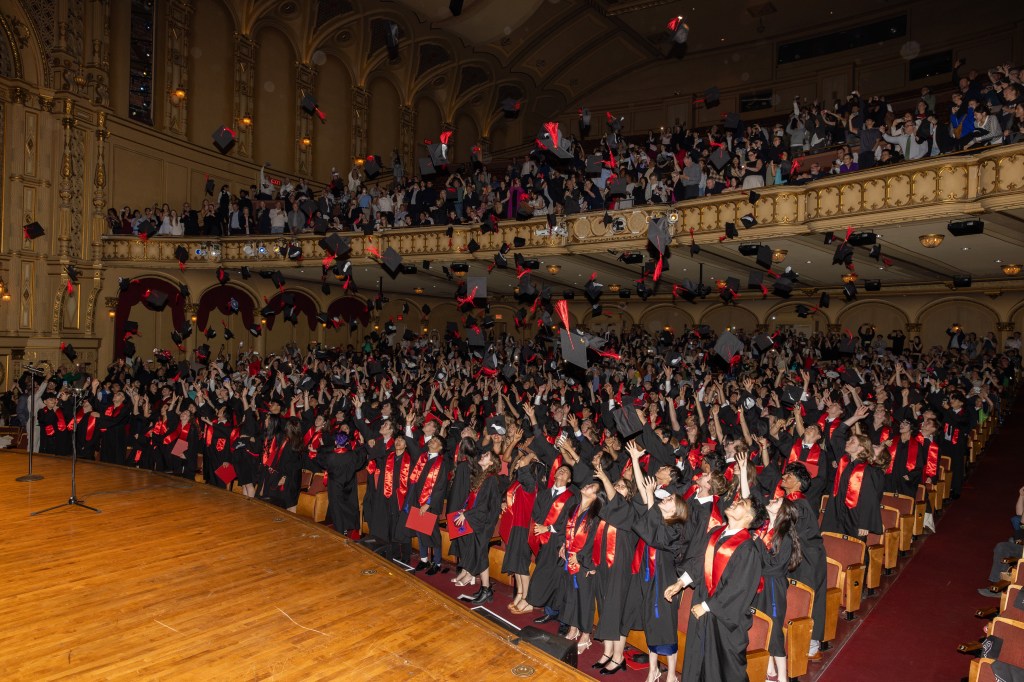
June is a particularly complex time in the school calendar. It is as much a time of reflection and completion as it is a season of transition and new beginnings. Across the school district, students, staff, and families find themselves marking important milestones and looking ahead to what comes next.
From Grade 7 leaving ceremonies, where students prepare to take their next steps into secondary school, to retirement celebrations honouring colleagues whose decades of service have shaped generations of learners, June reminds us that education is deeply connected to the passages and rhythms of our lives. These moments invite us to pause and recognize not only individual achievements, but also the relationships, commitments, and shared experiences that make NVSD schools such meaningful places.
Perhaps nowhere is this spirit of transition more evident than in our graduating students. The Class of 2026 stands at a unique threshold—looking back on years of learning, growth, challenge, and accomplishment, while also preparing to embrace opportunities that are still unfolding before them. Graduation provides moments to recognize the character, resilience, and aspirations that students carry with them into the future. It also presents the chance to witness how the hopes and dreams we hold for young people come into clearer focus. In this final post of the school year, I am pleased to share a message to our graduating class as they celebrate this significant milestone and prepare for the next chapter of their journeys. This message was initially prepared and delivered as part of the 38th annual Superintendent’s Celebration of Learning.
In sharing this reflection, I invite readers to return to some of the enduring questions at the heart of public education: What do we hope and dream for young people? What kinds of lives do we hope they will lead, and what capacities do we hope they will develop as learners, citizens, and human beings? In many ways, June offers an opportunity to consider the ends in mind…not simply the completion of another school year, but the broader purposes that animate our work together and give meaning to the daily experiences of teaching and learning.
Superintendent’s Address
Honoured guests,
Today, we recognize student leaders. And when we hear the word leadership, many of us instinctively think about visibility. We think of the loud voice, the captain, the person at the microphone, the person out front. But I want to suggest something different today.
Leadership, especially in the time we are living in, is stewardship. It is the intentional act of enabling a healthy community.
And that matters because healthy communities create what researchers sometimes call socially generative spaces; environments where people flourish together. Think about a truly healthy classroom, a strong team, or a connected school. In those spaces, not only do individuals do better, but the entire community becomes stronger, and society itself benefits.
History gives us examples of extraordinary communities where people achieved remarkable things together — not because one individual dominated, but because people were connected through trust, purpose, and care for one another. We may not be trying to change the entire world, but why would we not aspire to create those kinds of spaces wherever we are?
At its core, community means that every person can share their unique gifts.
That is such an important idea.
A healthy community is not about everybody becoming the same. It is about creating the conditions where each person can contribute who they truly are. And when that happens, iron sharpens iron. One person’s strength elevates another person’s strength. One person’s courage creates space for another person’s courage. One person’s kindness changes the emotional temperature of an entire room.
That is leadership.
And here is the irony: when leadership is working really well, people often do not even notice it happening. The healthiest communities are usually shaped quietly through consistency, attentiveness, inclusion, reliability, and care. Be wary of Narcissists.
But if leadership is stewardship of community, then it raises important questions:
- Do we recognize what unhealthy communities look like?
- Do we understand the actions that actually create healthy ones?
As you begin to wrestle with those questions, leadership becomes more complex. But complexity should never distract us from the simplicity of our own behaviour.
The fact that you are here today, recognized as leaders, says something important about you. It speaks to your willingness to contribute intentionally to the communities around you.
There is a powerful idea from political thinker Hannah Arendt, who distinguished between force and power.
Force is something imposed, but power emerges when people come together around shared purpose.
That distinction matters deeply today. We often live in a culture that celebrates the individual above all else. Yet the irony is this: the only place an individual can truly flourish is within a healthy system. The individual and the community are not opposites. They depend upon one another.
I often think about this through sports…. hockey, specifically.
You can have the most talented player on the ice, the player who scores the highlight-reel goals, but if the team around them is disconnected, selfish, or fragmented, they still lose game after game. Meanwhile, another team with no singular superstar can become exceptional because they understand trust, sacrifice, positioning, support, and collective efficacy — the shared belief that together we are stronger than any one individual alone… and how much more an individual’s excellence can shine on a great team or in a great community.
That is where true strength lies.
And that lesson extends far beyond sports. It applies to schools, workplaces, families, democracies, and communities.
I believe that one of the great misconceptions about leadership is that it is mostly about big moments. In reality, leadership is usually about small things:
- the greeting in the hallway;
- the willingness to listen before speaking;
- the courage to include;
- the discipline to remain thoughtful in difficult moments;
- the student who notices someone sitting alone;
- the teammate who encourages another player after a mistake;
- the person who follows through on a responsibility when nobody is watching.
Those moments may seem small, but over time, day after day, they shape culture, the way we act around here…And culture shapes community.
Graduates, as you leave this chapter and move into the next, I hope you carry this understanding of leadership with you. I hope you continue to harness the gifts that are being recognized today, because clearly what you are doing is making a difference. Whether you are entering the workforce, moving on to post-secondary education, or taking time to explore and reset, your ability to lead will matter.
The world does not simply need more successful people, it needs more stewards of healthy communities.
People who understand that compassion and competence belong together. People who understand that individual behaviour matters to collective success. People who recognize that collective strength is not weakness, but one of humanity’s greatest achievements.
And people who know that small acts repeated consistently over time can profoundly shape the lives of others.
Thank you for the leadership you have already shown.
 What Kind of Education for What Kind of World?
Leave a comment